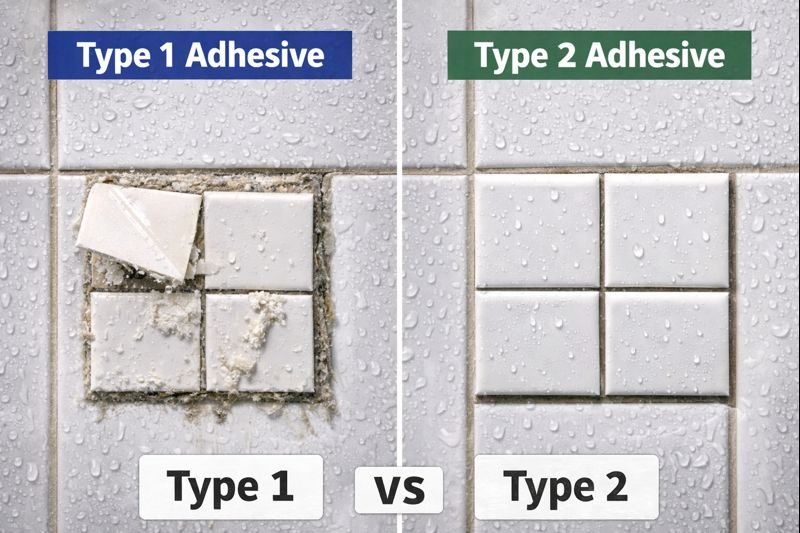
Are you struggling with tiles falling off walls in your bathroom? Using the wrong adhesive type is a common but costly mistake that can turn your renovation into a disaster.
Type 1 tile adhesive1 has better water resistance for intermittently wet areas like shower walls, while Type 2 adhesive2 is only suitable for completely dry areas. Neither should be used on floors or in constantly wet areas.
Let me share what I've learned after supplying materials for thousands of tile installation projects. Understanding the difference between these adhesives isn't just technical knowledge—it could save you from expensive repairs down the road.
What is Type 1 and type 2 tile adhesive?
Have you ever installed tiles only to watch them loosen or fall completely off the wall? This heartbreaking scenario often happens because of choosing the wrong adhesive type for specific conditions.
Type 1 and Type 2 are both premixed organic mastic adhesives. Type 1 offers enhanced water resistance and higher shear strength for intermittently wet areas, while Type 2 is a standard formula only suitable for completely dry environments.
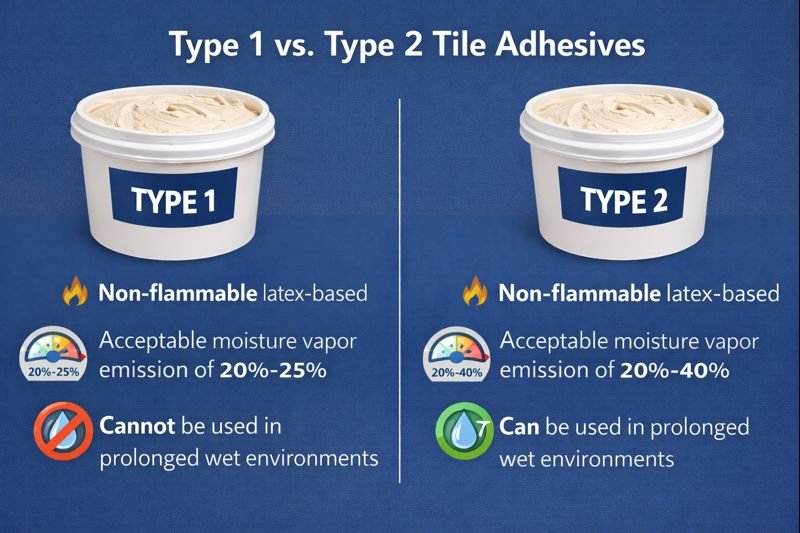
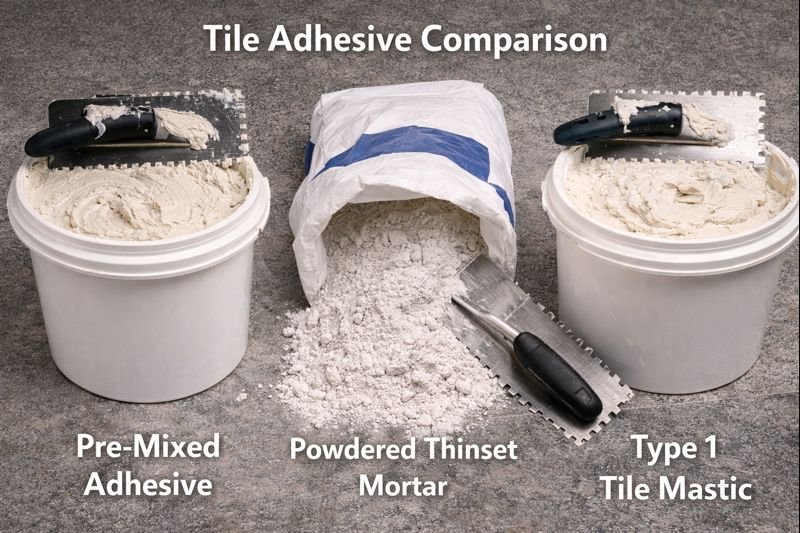
Both adhesive types belong to the mastic family, which are ready-mixed organic compounds that cure through water evaporation. This fundamental characteristic explains their limitations in wet environments. These products offer convenience—you simply open the bucket and start applying—but this convenience comes with significant performance restrictions.
Type 1 adhesives contain additional polymers and water-resistant additives that allow them to withstand occasional water exposure. This makes them suitable for shower walls where water contact is intermittent rather than constant. However, even Type 1 will eventually fail if regularly saturated with water.
Type 2 adhesive2s lack these water-resistant properties and should only be used in completely dry areas like kitchen backsplashes or decorative wall applications. They're essentially the basic version of mastic adhesive without enhanced properties.
Neither type should ever be used for floor installations, regardless of the room's humidity level. The horizontal orientation creates different stress patterns that these adhesives aren't designed to handle long-term.
Key Differences Between Type 1 and Type 2 Tile Adhesives
| Feature | Type 1 | Type 2 |
|---|---|---|
| Water Resistance | Moderate (intermittent exposure) | Poor (dry areas only) |
| Shear Strength | Higher | Standard |
| Application Areas | Shower walls, backsplashes | Dry walls, decorative areas |
| Floor Application | Not suitable | Not suitable |
| Curing Method | Water evaporation | Water evaporation |
| Cost | Higher | Lower |
What is the best type of tile adhesive?
Are you puzzled by the many adhesive options at your local store? Making the wrong choice could lead to expensive repairs and frustrating re-installations down the road.
The best tile adhesive isn't Type 1 or Type 2, but rather cement-based thinset mortar3. Thinset offers superior strength, durability, water resistance, and versatility for most tile installations, including floors and wet areas.
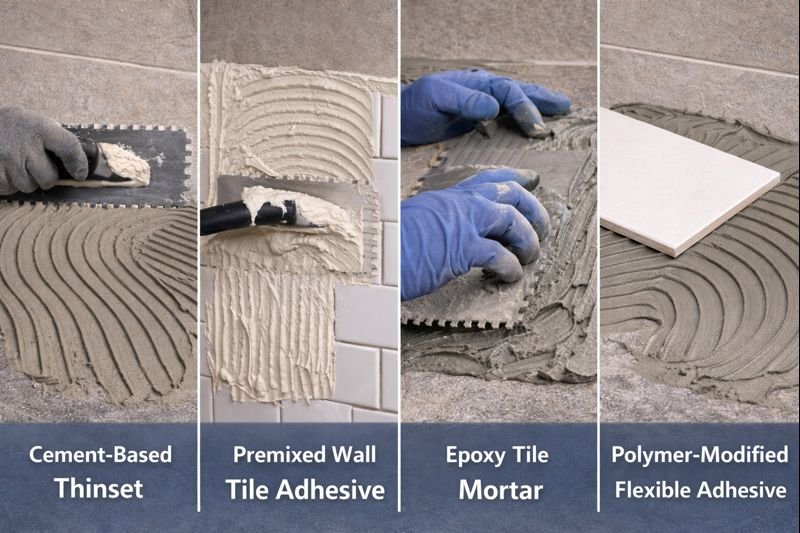
While Type 1 and Type 2 mastic adhesives offer convenience, they simply can't compete with cement-based thinset mortar in performance and durability. I've visited countless renovations where shortcuts were taken using mastic adhesives, only to require complete reinstallation within a few years.
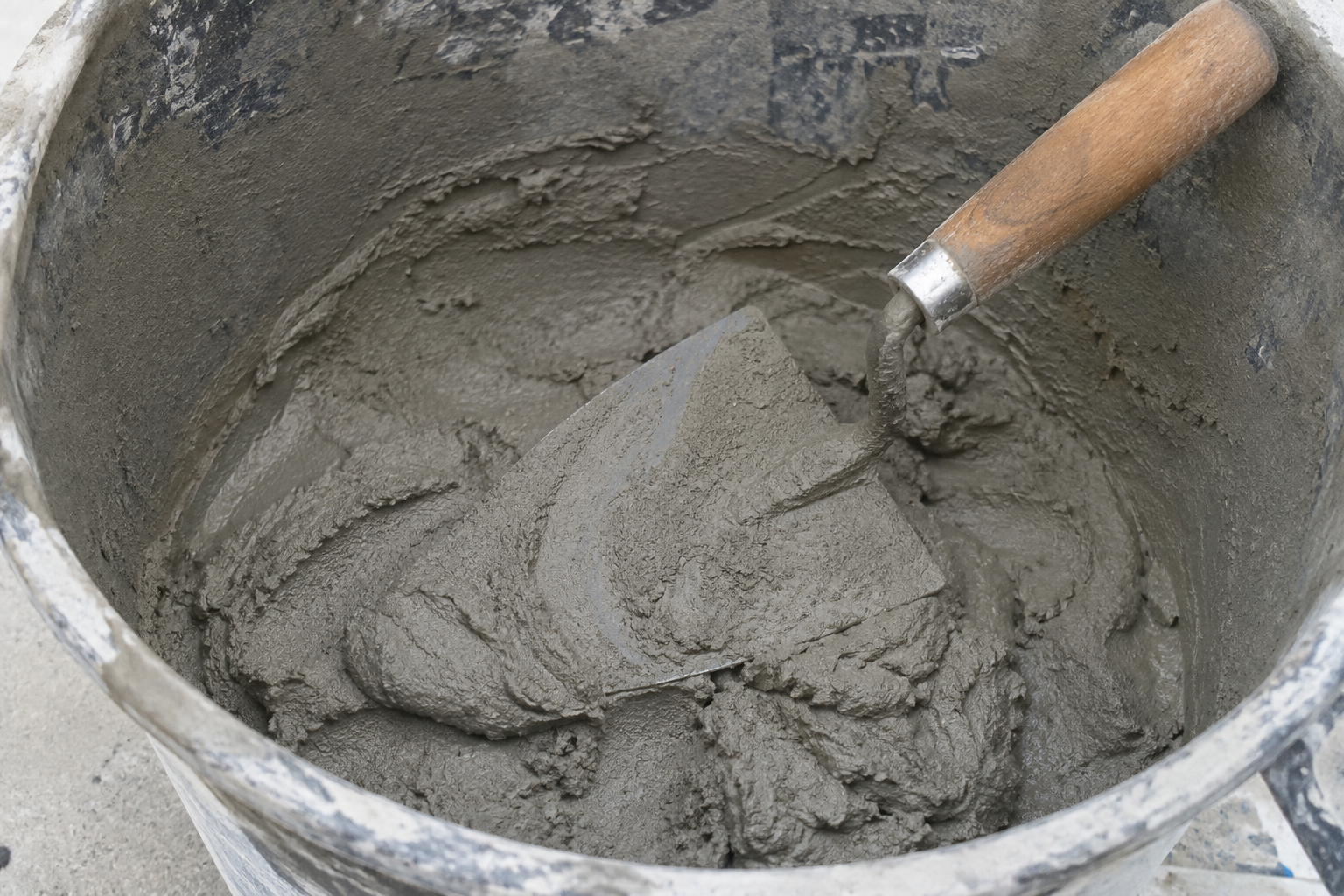
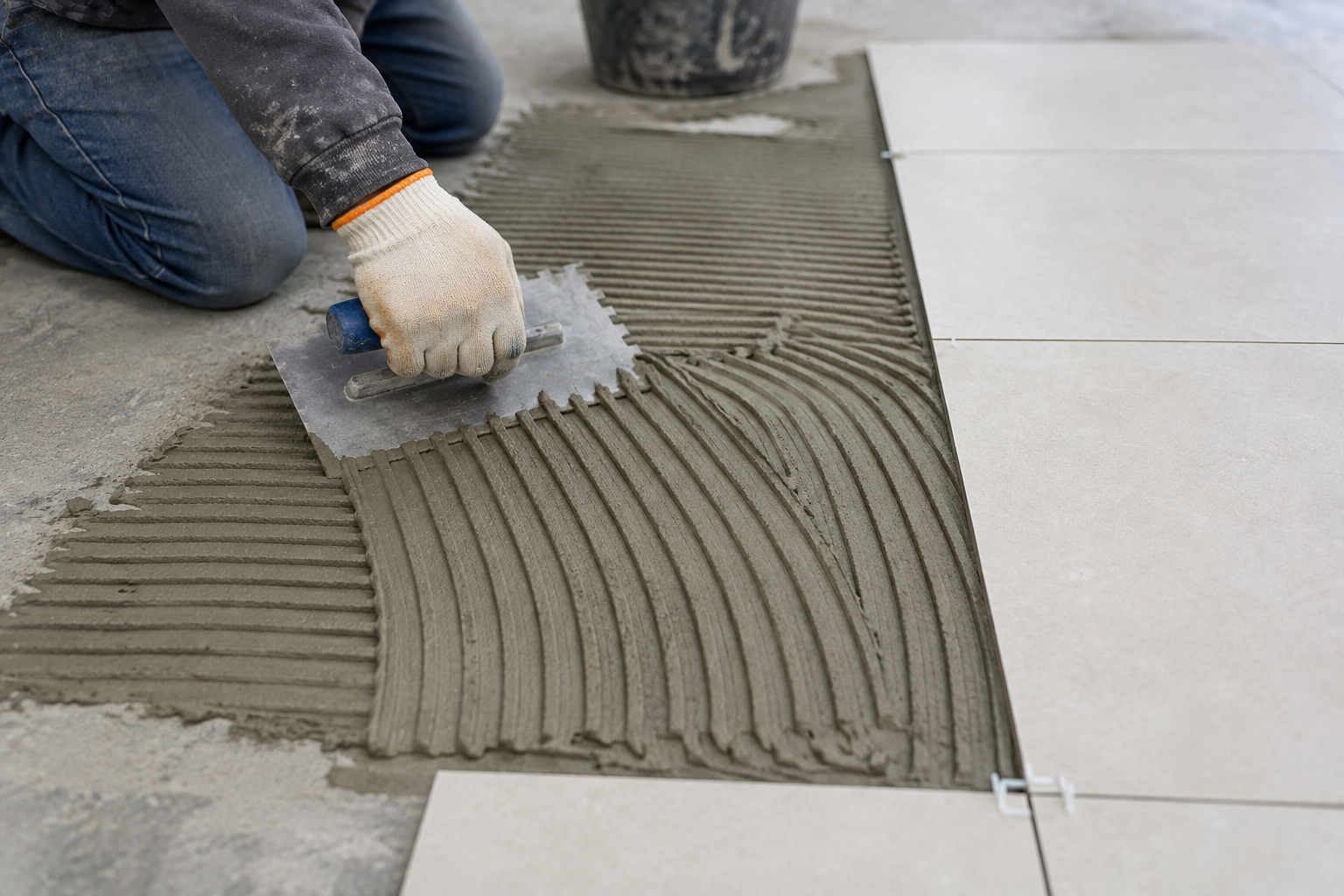
Thinset mortar is a mixture of cement, fine sand, and water-retention compounds that create a much stronger bond than any organic mastic adhesive. Unlike mastics that cure through water evaporation, thinset cures through a chemical reaction (hydration) that creates a permanent, water-resistant bond. This fundamental difference makes thinset substantially more durable in challenging environments.
Modified thinsets containing polymers offer even greater flexibility and adhesion. This makes them ideal for installations over difficult substrates or where some movement might occur. For extremely demanding installations, epoxy-based adhesives4 provide maximum strength and chemical resistance, though they're more expensive and challenging to work with.
Consider your specific project requirements when selecting an adhesive. Factors like tile size, substrate material, installation location, and exposure conditions all impact which product will perform best. For instance, large-format tiles require a thinset with higher flexibility ratings (S1 or S2 classification in European standards).
Tile Adhesive Comparison Chart
| Adhesive Type | Strength | Water Resistance | Application Areas | Skill Level Required |
|---|---|---|---|---|
| Type 1 Mastic | Moderate | Limited | Dry/intermittently wet walls | Beginner |
| Type 2 Mastic | Basic | Very poor | Dry walls only | Beginner |
| Standard Thinset | High | Good | Floors, walls, wet areas | Intermediate |
| Modified Thinset | Very high | Excellent | All applications | Intermediate |
| Epoxy Adhesive | Maximum | Excellent | Chemical/high stress areas | Advanced |
What is Type 1 tile adhesive1 used for?
Have you spent hours trying to figure out exactly where Type 1 adhesive can be safely used? Many homeowners waste money on failed installations because product limitations aren't clearly explained.
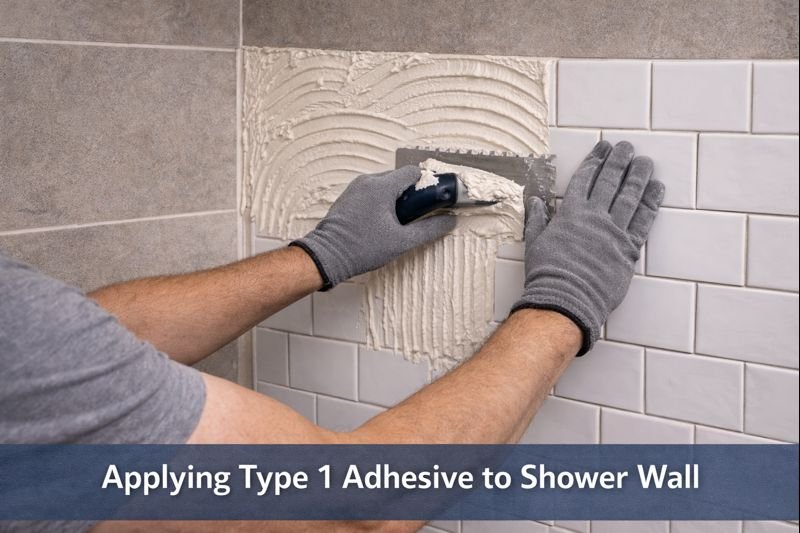
Type 1 tile adhesive is designed specifically for wall tile installations in areas with intermittent moisture exposure like shower walls (not floors), bathroom walls, and kitchen backsplashes. It should never be used for floor tiles, constantly wet areas, or exterior applications.
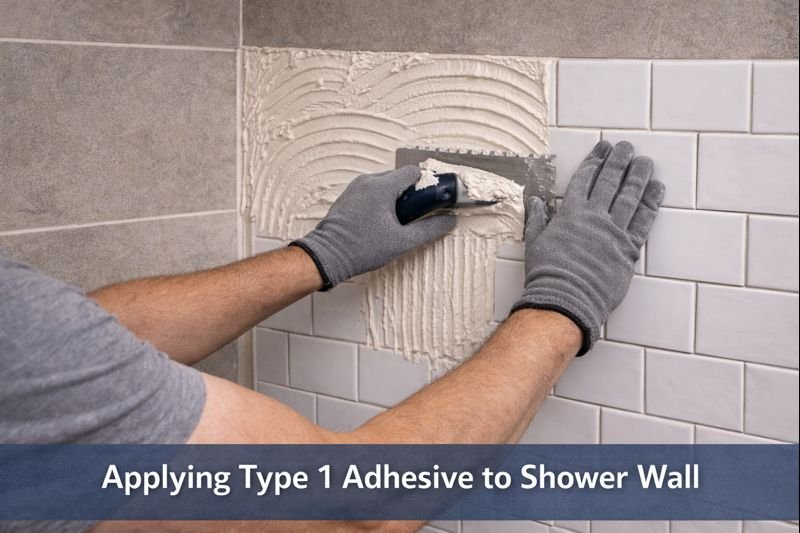
Type 1 adhesive occupies a specific niche in tile installation applications. In my experience supplying materials to countless contractors, I've found that Type 1 is most commonly used in residential bathroom renovations where convenience is prioritized over maximum performance.
The key advantage of Type 1 mastic is its ease of application—no mixing required and it remains workable for longer periods than thinset. This makes it appealing to DIY homeowners and contractors working on small projects where setup and cleanup efficiency matters. The adhesive comes ready to use straight from the bucket, saving preparation time.
However, Type 1 has significant limitations that must be respected. It should never be used for floor installations because the horizontal orientation creates different stress patterns that will cause failure over time. Similarly, exterior applications are completely unsuitable due to temperature fluctuations and moisture exposure.
Even in shower installations, Type 1 should only be used on walls—never shower floors, curbs, or any surface where water might pool. The material's water resistance is limited to intermittent exposure, not constant saturation. For shower floors or wet room applications, a waterproofing membrane and cement-based thinset mortar are absolutely necessary.
Type 1 also has limitations regarding tile size and weight. Most manufacturers recommend against using it with tiles larger than 8×8 inches or heavier stone tiles, as the adhesive doesn't provide adequate support for larger formats. Always check manufacturer specifications for maximum recommended tile dimensions.
Appropriate Applications for Type 1 Adhesive
| Application | Suitability | Notes |
|---|---|---|
| Shower Walls | Acceptable | Not for continuous wet exposure |
| Kitchen Backsplashes | Good | Ideal application |
| Bathroom Walls | Good | Away from direct water sources |
| Shower Floors | Not Suitable | Use thinset mortar instead |
| Any Floor Installation | Not Suitable | Use thinset mortar instead |
| Exterior Applications | Not Suitable | Use exterior-rated thinset |
| Large Format Tiles (>8×8") | Not Recommended | Check manufacturer specs |
What's the difference between S1 and S2 tile adhesive?
Are you confused by seeing S1 and S2 labels on cement-based adhesives? Understanding these classifications could prevent cracked tiles and failed installations, especially with large format tiles.
S1 and S2 designations refer to flexibility levels in cement-based thinset mortars. S1 adhesives have moderate deformability (≥2.5mm deflection) suitable for most installations, while S2 products offer higher flexibility (≥5mm deflection) for challenging substrates and large tiles.
S1 and S2 classifications5 come from European standards (EN 12004) and have become globally recognized indicators of a cement-based adhesive's flexibility. This is entirely different from the Type 1 and Type 2 designations for mastic adhesives discussed earlier, though the similar naming can cause confusion.
Flexibility in thinset is crucial because building materials expand, contract, and sometimes flex slightly with temperature changes, moisture variations, and structural loads. When these movements occur, rigid adhesives can crack or lose bond, while deformable adhesives accommodate these minor movements while maintaining their grip.
S1 classified thinsets offer moderate deformability, with the ability to deflect at least 2.5mm without losing adhesion or cracking. This makes them suitable for most normal residential and commercial installations, including situations with minor substrate movement or thermal stress. They're the standard choice for installations over in-floor heating systems where temperature fluctuations occur.
S2 classified products provide enhanced flexibility, with at least 5mm of possible deflection. These premium products are specifically designed for challenging installation environments like exterior facades, large-format tiles exceeding 24 inches, installations over wood substrates that may flex slightly, or areas with extreme temperature variations.
The increased flexibility comes from higher polymer content in the thinset formula, which also typically improves adhesion strength and water resistance. However, these benefits come at a higher cost—S2 products generally command a premium price over S1 alternatives.
When to Choose S1 vs S2 Adhesives
| Factor | S1 Recommendation | S2 Recommendation |
|---|---|---|
| Tile Size | Up to 24" | Larger than 24" |
| Substrate | Stable concrete, backer board | Wood, existing tile, slight movement |
| Location | Interior standard applications | Exterior, thermal stress areas |
| In-Floor Heating | Standard systems | High-temperature systems |
| Cost Consideration | Standard budget | Premium budget |
| Deflection Capacity | ≥2.5mm | ≥5mm |
What is the difference between Type 1 and Type 2 glue?
Have you ever wondered whether those adhesive labels actually matter? Using the wrong adhesive type has caused countless installation failures that could have been easily avoided.
The fundamental difference is water resistance: Type 1 glue contains water-resistant additives allowing it to withstand intermittent moisture exposure, while Type 2 offers virtually no water resistance and is limited to completely dry applications.
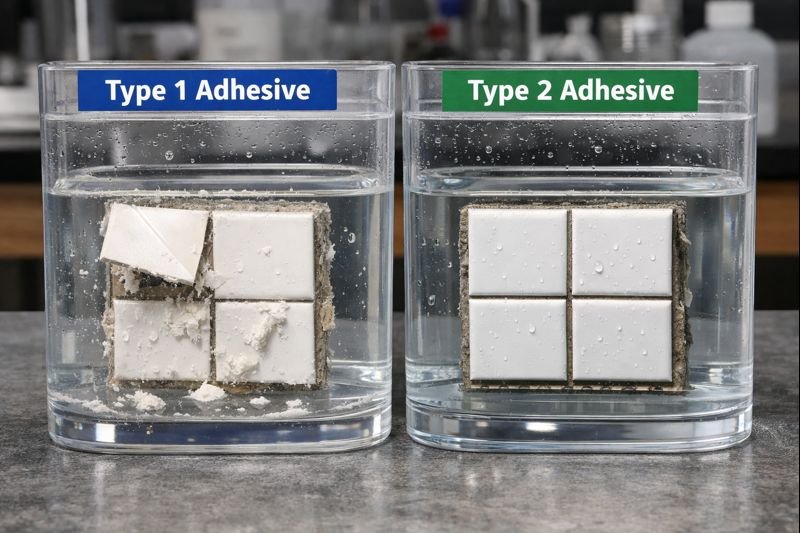
Beyond the primary difference in water resistance, there are several other important distinctions between Type 1 and Type 2 adhesives that influence where and how they should be used. I've seen plenty of installation failures where these differences weren't properly understood.
Type 1 adhesives contain specialized polymers and additives that not only enhance water resistance but also improve overall bond strength and shear resistance. This means they can withstand greater forces trying to separate the tile from the substrate. The formulation typically includes fungicides to prevent mold growth in damper environments, addressing a common concern in bathroom installations.
Type 2 adhesive2s lack these enhancements, making them simpler formulations with lower performance characteristics across the board. They generally have shorter working times and less grab strength, though they may be slightly less expensive. The absence of water-resistant additives means they begin to deteriorate quickly when exposed to moisture.
Both types share fundamental limitations as organic mastic adhesives. They cure through water evaporation rather than chemical reaction, which means they should never be used in thick applications or with impervious materials that would prevent proper drying. This is why neither is suitable for floor applications where uniform support is crucial.
Understanding these differences helps explain why professional installers rarely use Type 2 adhesive at all—the minor cost savings simply don't justify the significant performance limitations. When budget constraints are a concern, a standard unmodified thinset often proves more economical and certainly more versatile than Type 2 mastic.
Performance Comparison: Type 1 vs Type 2
| Performance Aspect | Type 1 | Type 2 |
|---|---|---|
| Water Resistance | Moderate | Very Poor |
| Bond Strength | Better | Basic |
| Shear Resistance | Higher | Lower |
| Working Time | Longer | Shorter |
| Mold Resistance | Contains fungicides | Limited or none |
| Cost | Higher | Lower |
| Professional Use | Limited applications | Rarely used |
Conclusion
Remember that Type 1 adhesive offers moderate water resistance for intermittently wet areas like shower walls, while Type 2 is only for completely dry spaces. For floors or constantly wet areas, always use cement-based thinset mortar instead of any mastic adhesive.
FAQ
Can I use Type 1 adhesive on shower floors?
No, shower floors need cement-based thinset mortar as they experience constant water exposure that will cause Type 1 to fail.
How long does Type 1 adhesive last?
When properly applied in suitable conditions, Type 1 can last 10+ years, but will deteriorate faster in areas with frequent moisture exposure.
Is Type 1 or Type 2 better for kitchen backsplashes?
Type 1 is better for kitchen backsplashes due to its improved moisture resistance, though Type 2 can work if the area stays completely dry.
Can large format tiles be installed with Type 1 adhesive?
No, tiles larger than 8×8 inches generally require cement-based thinset mortar for proper support and bond strength.
What's the difference between mastic and thinset mortar?
Mastic is a premixed organic adhesive that cures through evaporation, while thinset is a cement-based product that cures through chemical hydration, offering superior strength and water resistance.
-
Explore this link to understand the specific applications and limitations of Type 1 tile adhesive, ensuring you make informed choices. ↩ ↩
-
Learn about Type 2 adhesive's applications and why it's crucial to use it correctly to avoid costly mistakes. ↩ ↩ ↩
-
Explore the advantages of cement-based thinset mortar over mastic adhesives for superior tile installations. ↩
-
Find out why epoxy-based adhesives are ideal for high-stress areas and their unique properties. ↩
-
Discover the significance of S1 and S2 classifications and how they affect adhesive flexibility and performance. ↩