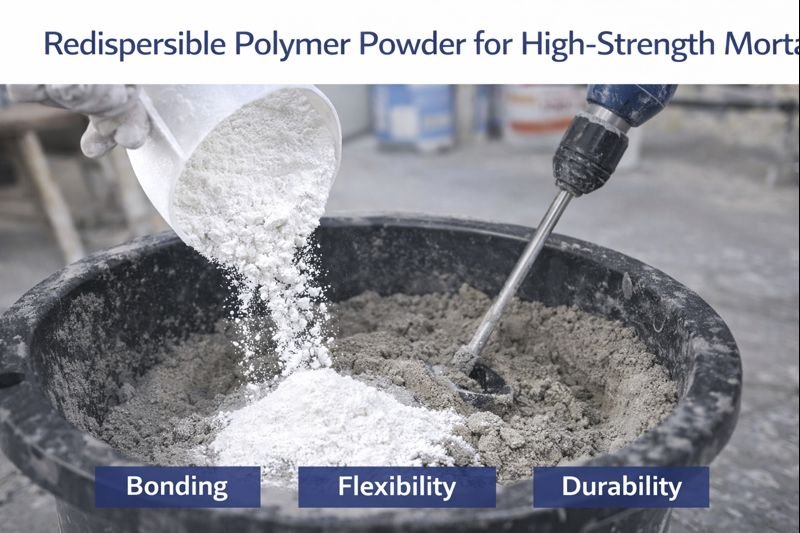
Your regular cement-based mortar keeps cracking under pressure, causing costly repairs and frustrated clients. Structural stability issues plague your projects, and traditional solutions just don't hold up in demanding environments.
Redispersible polymer powder1 enhances mortar by adding flexibility, adhesion, and durability. It creates a polymer film network between cement particles, making the mortar less brittle while maintaining strength. This modification significantly improves performance in high-stress applications and extreme weather conditions.
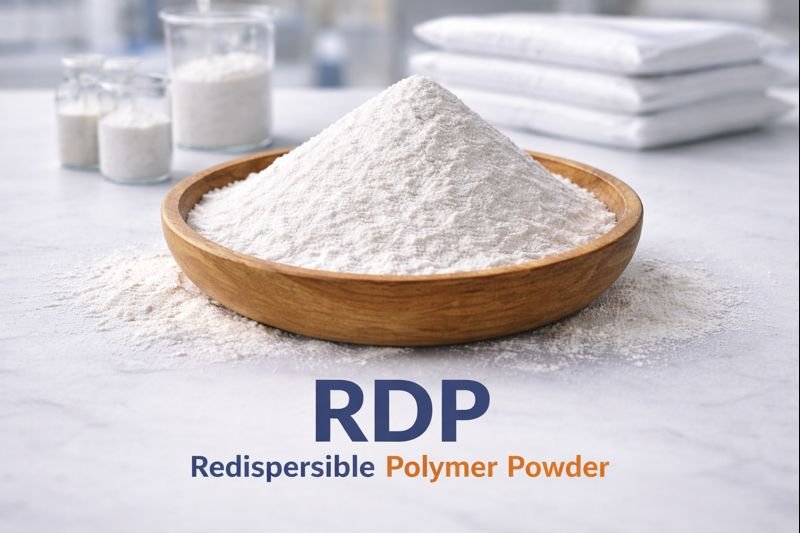
Think about high-strength cement mortar without polymer additives—it's like tempered glass. It's hard for sure, but too brittle. Any temperature changes or vibrations, and cracks appear. This is what we call "rigidity without flexibility." I've seen countless projects fail because they focused only on compressive strength while ignoring flexibility.
What is Redispersible Polymer Powder Used For?
Many contractors struggle with mortar that can't adapt to building movements or bind properly to difficult substrates. Traditional formulations fail prematurely, leading to costly callbacks and damaged reputations.
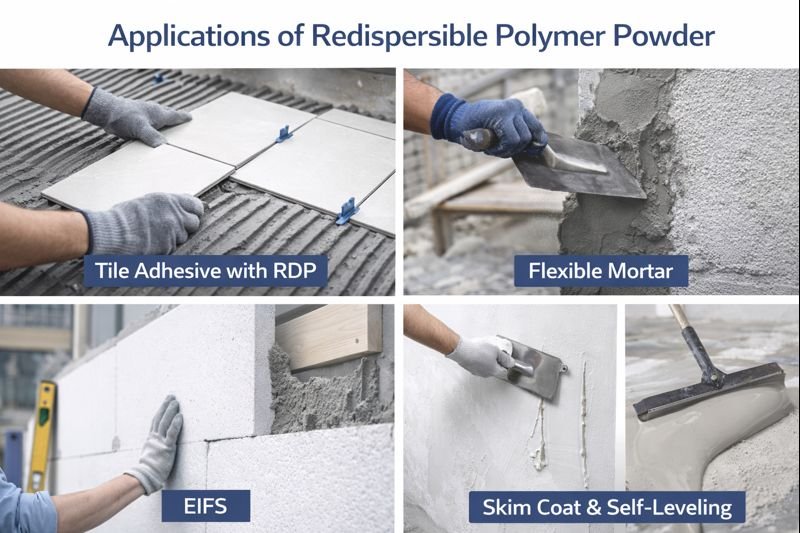
Redispersible polymer powder1 is used to modify cementitious systems including tile adhesives2, repair mortars3, self-leveling compounds4, external insulation systems, and waterproofing mixtures. It disperses in water during mixing and forms a polymer film during drying, enhancing the mortar's performance characteristics.
The magic of redispersible polymer powder (RDP) happens at the microscopic level. When mixed with water, these tiny polymer particles disperse throughout the mortar mixture. As the water evaporates, they form an interconnected network of flexible polymer films that bridge between cement and aggregate particles. This network functions like invisible reinforcement fibers scattered throughout the mortar matrix.
RDP isn't just for one application—it's remarkably versatile. I've successfully used it in:
Where RDP Makes the Biggest Difference:
| Application | How RDP Helps | Typical Dosage |
|---|---|---|
| Tile Adhesives | Prevents tiles from popping off surfaces, especially in wet areas | 2-5% by weight |
| Repair Mortars | Ensures new material bonds properly to old substrates | 3-7% by weight |
| External Insulation | Improves impact resistance and weather durability | 3-6% by weight |
| Self-leveling Compounds | Reduces cracking and improves flow properties | 1-3% by weight |
| Waterproofing Mixtures | Enhances water resistance and flexibility | 5-10% by weight |
I recently visited a project where the contractor had used unmodified mortar for exterior tile work. After just one season of temperature cycles, tiles were detaching. The replacement mortar with proper RDP content solved the problem permanently, saving thousands in future repairs.
What are the Advantages of Polymer Modified Cementitious Mortar?
Standard mortars often fall short in challenging conditions—poor adhesion to smooth surfaces, brittleness under stress, and low resistance to water penetration cause recurring headaches in construction projects.
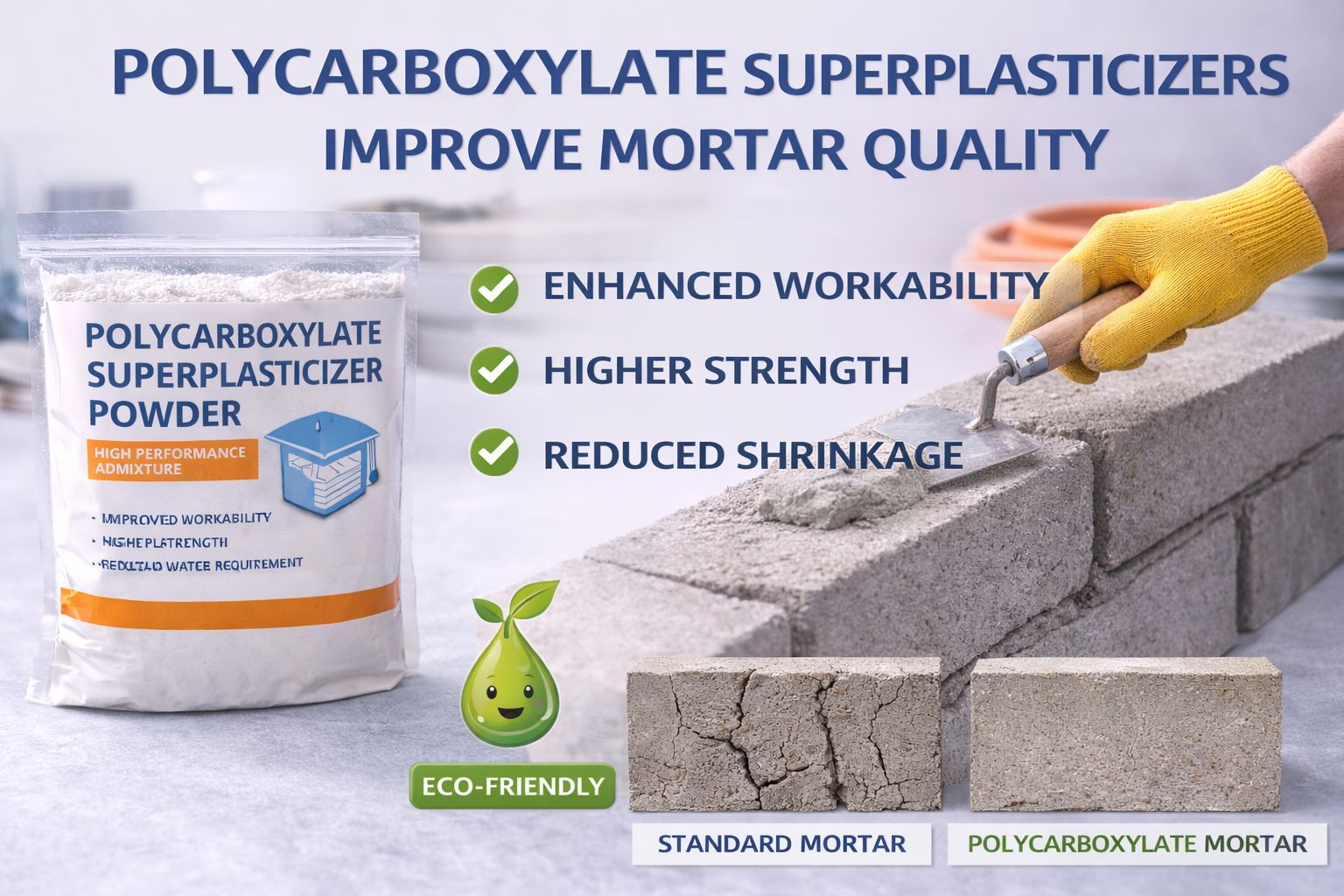
Polymer modified cementitious mortars offer superior adhesion to difficult substrates, enhanced flexibility to resist cracking, improved water resistance, better freeze-thaw durability, and increased abrasion resistance. These properties make them ideal for demanding applications where conventional mortars would fail.
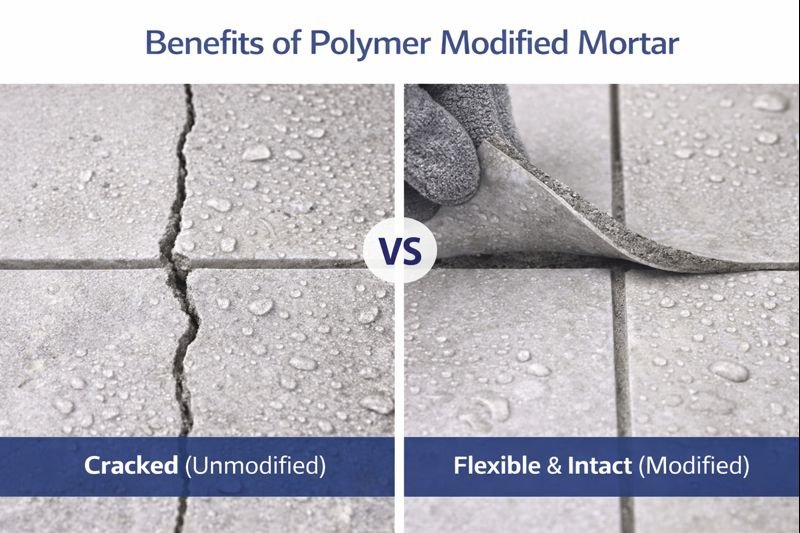
The advantages of polymer-modified mortars go far beyond basic performance improvements. I've conducted side-by-side tests that demonstrated remarkable differences. When I applied both standard and polymer-modified mortars to polished concrete (a notoriously difficult substrate), the standard mortar could be peeled off with minimal effort after curing, while the polymer-modified version required mechanical removal.
The polymer modification creates a fundamentally different material behavior pattern. Let's break down the key advantages:
Critical Performance Improvements with Polymer Modification:
-
Enhanced Adhesion: The polymer forms chemical bonds with substrates that cement alone cannot achieve. This is especially important on smooth or non-porous surfaces where mechanical bonding is limited.
-
Flexibility and Crack Resistance: The polymer film's elasticity allows the mortar to absorb minor movements without cracking. I've measured up to 300% improvement in elongation before failure compared to unmodified mortars.
-
Durability Under Stress: Polymer-modified mortars show significantly better performance under:
- Freeze-thaw cycles (crucial in cold climates)
- Wet-dry cycles (important in exterior applications)
- Impact loading (essential for floor applications)
For a recent high-rise project, we faced severe wind-driven rain conditions that had previously caused water infiltration through the facade. By switching to a polymer-modified weatherproofing mortar, we eliminated all water penetration issues, even during monsoon season testing.
What Does Polymer Do for Mortar?
Traditional mortar often suffers from fundamental weaknesses—poor tensile strength, limited flexibility, and insufficient bonding to modern building materials, leading to premature failure and ongoing maintenance issues.
Polymers create flexible films between cement particles that improve mortar's tensile strength, flexibility, and adhesion. They reduce water permeability by filling capillary pores and enhance workability during application. The polymer network acts as internal reinforcement that complements cement's natural compressive strength.
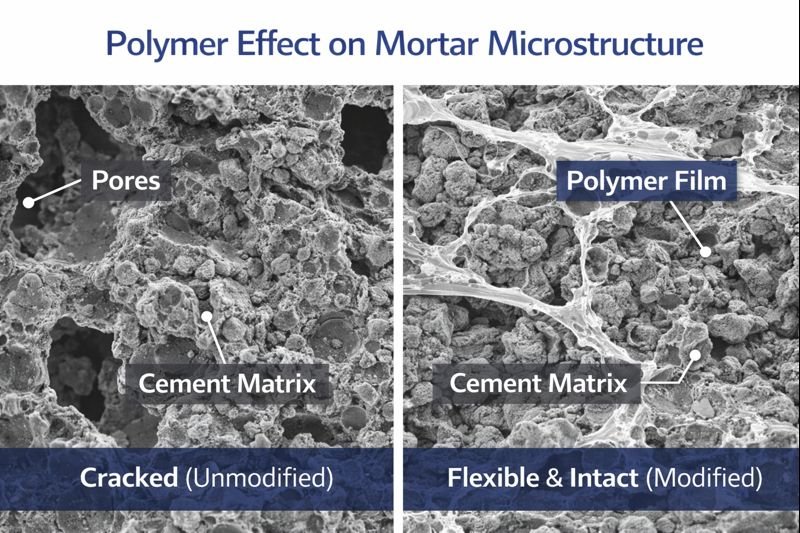
The relationship between cement and polymer in modified mortar reminds me of composite materials like carbon fiber—each component contributes distinct properties that compensate for the other's weaknesses. Cement provides the compressive strength and rigidity, while the polymer delivers flexibility and adhesion.
When I explain this to clients, I use this analogy: cement-only mortar is like tempered glass—hard but brittle. Adding RDP is like giving that glass an internal flexible mesh that holds everything together even under stress.
At the microstructural level, several critical processes occur:
The Polymer's Multifunctional Role:
-
Film Formation: During drying, the dispersed polymer particles coalesce to form continuous, elastic films that interlock with the cement hydration products.
-
Pore Blocking: Polymers fill and seal microscopic capillary pores in the cement matrix, significantly reducing water absorption. I've measured water permeability reductions of up to 80% compared to standard mortars.
-
Interface Enhancement: The polymer creates stronger transition zones between:
- Cement paste and aggregates
- Mortar and the substrate
- New mortar and existing materials (in repair applications)
-
Chemical Interactions: Some polymers (particularly those with carboxyl groups) can react with calcium ions in cement, forming additional binding compounds that further strengthen the material.
The polymer content must be carefully balanced—too little won't provide sufficient modification, while too much can overly reduce strength. Based on my testing, most applications benefit from 3-5% polymer content, though special applications like waterproofing membranes may require up to 10%.
What are the Advantages of Polymer Concrete?
Conventional concrete structures face serious challenges: stress cracking, premature deterioration in harsh environments, weak bond lines, and poor chemical resistance—all leading to shortened service life and increased life-cycle costs.
Polymer concrete offers exceptional durability, superior chemical resistance, rapid curing, minimal shrinkage, and excellent adhesion to existing concrete. These properties make it ideal for repair projects, industrial flooring, bridge deck overlays, and applications exposed to aggressive chemicals or harsh environments.
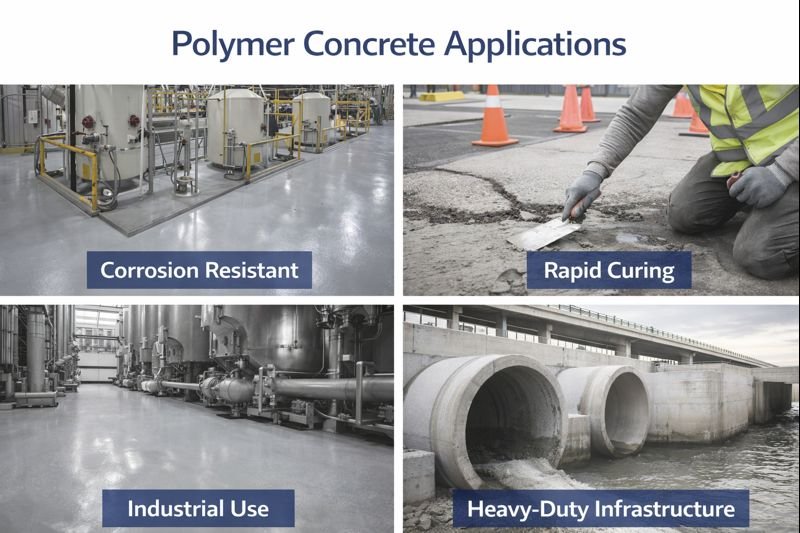
Polymer concrete represents the evolution of polymer modification, where the polymer content is significantly increased to create a fundamentally different material. While polymer-modified mortar still relies primarily on cement as the binder with polymer enhancement, polymer concrete uses the polymer as a primary binding agent.
I recently specified polymer concrete for a chemical processing facility where traditional concrete had failed after just three years of exposure. The polymer concrete is now entering its tenth year with minimal signs of deterioration, despite constant exposure to acids and cleaning chemicals.
When Polymer Concrete Outperforms Standard Concrete:
| Property | Improvement vs. Standard Concrete | Real-World Benefit |
|---|---|---|
| Chemical Resistance | 5-20× better resistance to acids, bases, and solvents | Extended service life in industrial environments |
| Curing Time | Functional strength in hours vs. days | Faster return to service, reduced downtime |
| Tensile Strength | 2-3× higher | Better resistance to cracking under load |
| Water Absorption | 80-95% lower | Near-waterproof performance |
| Adhesion Strength | 3-5× higher bond strength to existing concrete | Excellent for overlays and repairs |
Polymer concrete isn't right for every application—its higher cost (typically 3-5× traditional concrete) makes it best suited for specialized applications where its unique properties justify the investment. However, in those applications, no other material can match its combination of properties.
For a recent wastewater treatment facility project, we used polymer concrete for channels and containment areas exposed to highly aggressive chemicals. Despite the higher initial cost, the calculated lifecycle cost was 40% lower than standard concrete due to the eliminated need for replacements and associated downtime.
Conclusion
Redispersible polymer powder1 transforms ordinary mortar into a high-performance building material by adding flexibility, adhesion, and durability. This seemingly small addition makes the critical difference between structures that crack and fail versus those that stand the test of time.
-
Explore how RDP improves mortar performance, making it essential for construction projects. ↩ ↩ ↩
-
Learn how to effectively use tile adhesives for better results in your projects. ↩
-
Discover the best repair mortars to ensure lasting repairs in your projects. ↩
-
Understand the benefits of self-leveling compounds for smooth surfaces. ↩